
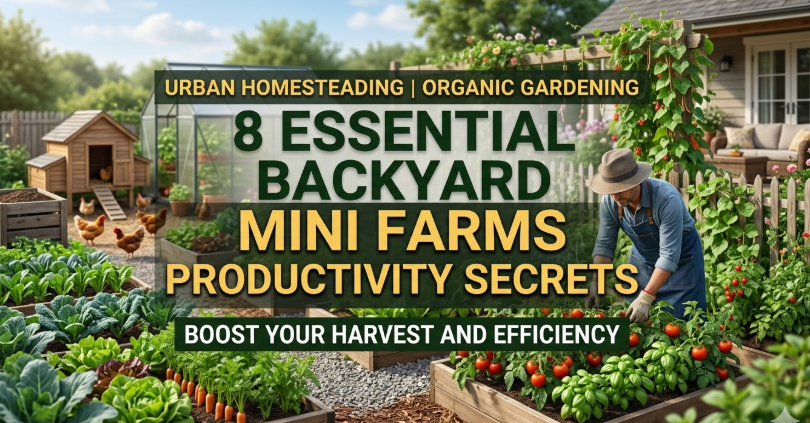
Meta Description: Backyard mini farms productivity secrets will turn even the smallest yard into a self-sustaining food source. 8 Proven Techniques To Grow More Food In Less Time And Increase Your Harvest.
8 Backyard Mini Farms Productivity Secrets That REALLY WORK
Your Backyard Can Feed Your Family — Here’s How
As most people look out into their backyard, they see a lawn.
Smart growers see a food factory in the same space.
Your mini farm does not have to be big. It requires no high-tech equipment. It doesn’t require years of experience. What it needs is the right strategy.
That’s precisely what this article provides you with.
So whether you have 100 square feet or 1,000 square feet to work with, here are the 8 productivity secrets for your backyard mini farm that help you grow more food in less time, remove the guesswork and make sure you actually enjoy gardening.
Let’s dig in.
Secret #1 — Plot Your Garden Before Planting a Seed
The single largest mistake that new growers make is planting randomly.
They purchase seeds, dig a hole and cross their fingers. That rarely works out.
Before anything is in the ground, you want to know what your plan is. Note specific times of day. Take note of where the sun hits and where it doesn’t. Check low spots where water gathers after rain.
Sun Mapping: The One Step Most Gardeners Forget
Plants need sunlight to grow. That sounds simple enough, but many people underestimate how much shade their yard really gets.
Here is a simple rule:
- Full sun plants (tomatoes, peppers, squash) require 6–8 hours of direct sunlight each day
- Partial sun crops (lettuce, herbs, kale) do well with 3–5 hours
- Shade-loving crops (spinach, mint, parsley) need only 2–3 hours
Mark where the sun strikes every 2 hours for one full day. A simple notebook, or even your phone’s notes app, will do. This one-time effort prevents you from putting sun-loving tomatoes into a shady corner — a mistake that suffocates your harvest before it even begins.
Draw a Simple Garden Map
You don’t need design software. A pencil and a piece of paper will work fine.
Sketch your yard. Mark:
- Sunny zones (6+ hours)
- Partial sun zones (3–5 hours)
- Shady zones (under 3 hours)
- Water access points
- Any slopes or problem areas
This map is your long-range plan. Every planting decision beyond this point radiates from this simple drawing.
A well-planned backyard mini farm can yield 3 to 5 times the amount of food as an unplanned mini farm of the same size. That is no exaggeration — it’s what happens when you stop playing guessing games and start working from a master plan.
Secret #2 — Go Vertical and Double Your Growing Space Instantly
Flat ground is precious. But it’s the only dimension most backyard growers ever use.
One of the biggest backyard mini farms productivity secrets beginners miss is vertical growing. Instead of spreading out, you go up. Fences, trellises, walls and arches all become growing space.
Crops That Love to Climb
Not every plant is a climber, but many of your favorites are. These crops thrive on vertical structures:
| Crop | Support Needed | Avg. Yield Per Plant |
|---|---|---|
| Cucumbers | Trellis or wire | 10–20 fruits |
| Pole beans | String or net | 200–300 beans |
| Peas | Mesh or sticks | 1–2 lbs |
| Cherry tomatoes | Cage or stake | 4–8 lbs |
| Squash (small varieties) | Strong trellis | 5–10 lbs |
| Bitter melon | Lattice or rope | 15–25 fruits |
A basic trellis of bamboo poles and garden twine is nearly cost-free. And it takes up the same ground footprint as a single creeping plant, while supporting 6–10 cucumber plants worth of growing space.
Stacking Layers Like a Pro
Vertical growing is also about layering.
Tall plants at the back. Medium plants in the middle. Low-growing plants at the front. This means more crops per square foot with zero additional land.
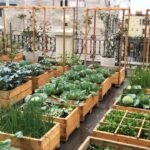
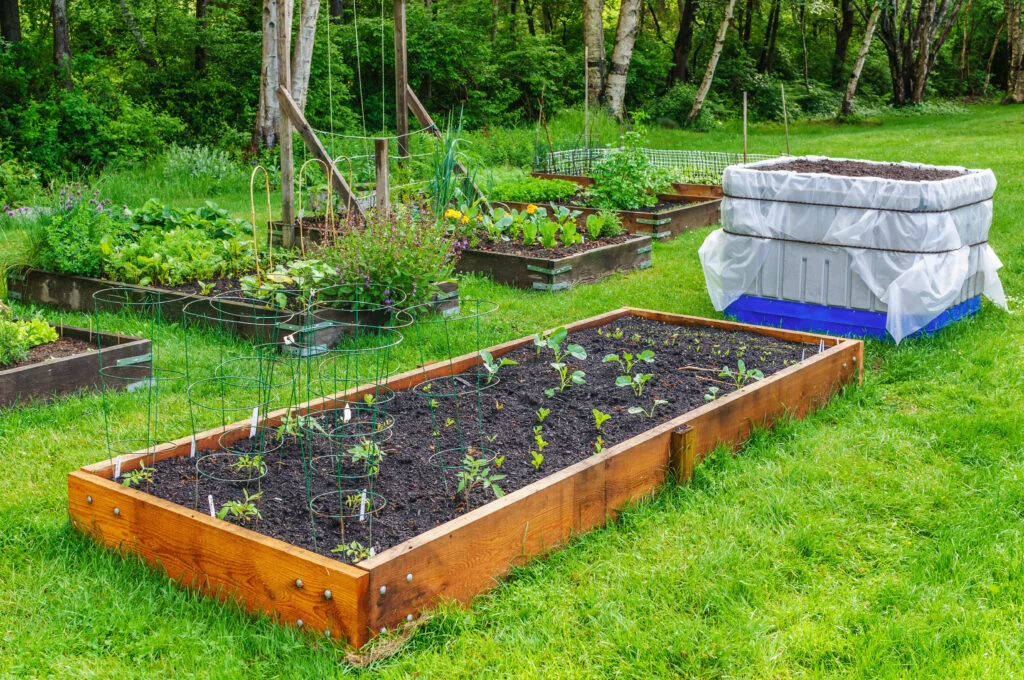
One 4×8 bed with vertical structures can produce the same amount as a flat 8×16 bed. You just doubled your yield without touching more land.
Secret #3 — Feed Your Soil, Not Just Your Plants
Most gardeners feed their plants.
Productive growers feed their soil.
There is a big difference. Good soil feeds your plants on autopilot for months and years. Unhealthy soil means you need to keep adding fertilizers — and even that’s not as effective as you’d like it to be.
What Makes Soil Truly Productive
Three things make great garden soil:
- Good structure — loose enough that roots can penetrate and push through, but firm enough to retain moisture
- Organic matter — broken down plant material, compost and manure that nourish soil life
- Living biology — billions of bacteria, fungi and earthworms that decompose nutrients and bring them to plant roots
You can cheaply test your soil with a home kit from any garden store. Backyard mini farm soils typically need more organic matter, improved drainage or a pH adjustment.
Compost Is Your Secret Weapon
Compost is decayed kitchen and garden waste. It costs nothing to produce, and it turns substandard soil into black, fertile, productive dirt.
Start a compost pile with:
- Kitchen waste (vegetable peels, coffee grounds, eggshells)
- Dried garden waste (leaves, grass clippings, prunings)
- A splash of water and periodic turning
In 8–12 weeks you’ll have compost that enhances drainage, nutrients and microbial life all at once.
Top-dress your beds with 2–3 inches of compost every season. This one habit separates an average grower from a truly productive one.
Secret #4 — Succession Planting Ensures a Continuous Harvest Throughout the Season
This is a common backyard mini farm dilemma.
You plant everything at once. Everything matures at once. You’re buried in zucchini for two weeks — and then? Nothing.
Succession planting solves this completely.
What Succession Planting Actually Means
Rather than planting all your lettuce seeds on the same day, you plant a small batch every 2–3 weeks. That way, when one batch wraps up, the next is just beginning production.
It’s like a conveyor belt of fresh food — it just keeps coming at a pace you can actually manage.
A Simple Succession Planting Schedule
| Crop | Planting Frequency | Why It Works |
|---|---|---|
| Lettuce | Every 2–3 weeks | Bolts quickly in heat — staggering extends the season |
| Radishes | Every 2 weeks | Ready in 25–30 days, easy to re-plant |
| Cilantro | Every 3 weeks | Bolts quickly, rotation keeps fresh supply |
| Spinach | Every 2–3 weeks | Best in cool weather, brief harvest window |
| Beans | Every 3 weeks | Heavy producer but short peak harvest |
| Basil | Every 4 weeks | Keeps fresh fragrant leaves coming |
Doing this also distributes your workload. Instead of one giant harvest day that wipes you out, you pick little bits regularly.
Succession planting is one of the easiest backyard mini farms productivity secrets — and one that very few beginners ever use.
Secret #5 — Water Less, But Water Better
Drought kills some plants, but overwatering kills more.
That is a lesson any new grower discovers the hard way.
Watering smart means giving plants the right amount of water, at the right time and in the right place. When done correctly, smart watering also saves you a lot of time and money.
The Case for Drip Irrigation
Drip irrigation delivers water directly to each plant’s root zone. It does not wet the leaves (preventing fungal disease). It does not water the paths between beds (which cuts down on weed growth).
A basic drip system starter kit will run you $30–$80. It connects to a typical garden hose and can cover an entire 4×8 raised bed.
The benefits are real:
- Requires 30–50% less water than hand watering
- Keeps bare soil dry, reducing weeds
- Helps reduce leaf diseases associated with wet foliage
- Can be automated with a timer ($15–$25)
Watering Checklist: The Finger Test
Before watering, insert your finger 2 inches into the soil. If it feels damp, don’t water that day. If it feels dry, give it a deep watering.
It takes 5 seconds and saves thousands of gallons by season’s end.
If possible, water in the early morning. This gives plants what they need for the day and lets any damp leaves dry quickly in the morning sun.
Secret #6 — Choose High-Value, High-Yield Crops Strategically
Not all vegetables are the same.
Some take months to mature and yield only a few pounds. Others produce all season long from a small area. Choosing the right crops matters enormously for a productive backyard mini farm.
Small Space, Big Returns: The Best Crops to Grow
Consider value along two axes: food per square foot and money saved relative to retail prices.
| Crop | Space Needed | Avg. Yield | Approx. Store Value |
|---|---|---|---|
| Cherry tomatoes | 2 sq ft | 4–8 lbs | $6–$12/lb |
| Herbs (basil, cilantro) | 1 sq ft | Continuous harvest | $3–$5/bunch |
| Salad greens | 1 sq ft | Cut & come again | $4–$6/bag |
| Kale | 1.5 sq ft | Long harvest season | $3–$4/bunch |
| Peppers | 2 sq ft | 20–30 fruits/plant | $2–$4 each |
| Zucchini | 4 sq ft | Very heavy producer | $2–$3 each |
Herbs are especially valuable. One basil plant in 1 square foot can replace dozens of store-bought bunches over a season — saving easily $50–$100 on grocery bills.
For more crop planning tips and space-saving ideas, Backyard Mini Farms is packed with practical guides to help you get the most out of every square foot.
What to Avoid in Small Spaces
Some crops require too much space relative to their yield in a mini farm environment:
- Corn — requires large blocks for pollination, low return per square foot
- Pumpkins — sprawling vines consume your space
- Watermelons — same problem; best grown elsewhere or trained vertically on a sturdy trellis
Focus on crops that provide persistent yields rather than one-and-done harvests.
Secret #7 — Beat Pests with Companion Planting
Pesticides cost money. They also kill beneficial insects — the ones that truly help your garden.
Companion planting offers a smarter solution. It means placing certain plants close together because they support each other’s growth.
Why Companion Planting Works
Plants communicate through their roots and by releasing chemicals into the air. Some combinations naturally:
- Repel specific pests
- Attract helpful insects that eat pests
- Enhance each other’s flavor or growth
- Provide different nutrients so they don’t compete
The Best Companion Planting Combinations
| Plant | Good Companions | What It Does |
|---|---|---|
| Tomatoes | Basil, marigolds | Basil improves flavor; marigolds repel aphids |
| Carrots | Onions, leeks | Confuse carrot fly with strong scent |
| Cucumbers | Nasturtiums, dill | Nasturtiums trap aphids away from cucumbers |
| Beans | Squash, corn | Classic “Three Sisters” system, shares nutrients |
| Cabbage | Mint, thyme | Strong herbs repel cabbage moths |
| Peppers | Spinach | Spinach makes use of the shade from pepper plants |
According to research published by the Rodale Institute, strategic companion planting can significantly reduce pest pressure while improving overall soil health — without a single drop of chemical pesticide.
Marigolds deserve special mention. Plant them along the edges of any bed. They ward off nematodes, aphids and whiteflies — and even rabbits. They also attract bees, which helps pollinate your whole backyard mini farm.
This is one of those backyard mini farms productivity secrets that costs almost nothing and pays big dividends season after season.
Secret #8 — Track Everything and Optimize Every Season
The most productive growers are more than just gardeners. They are also record keepers.
Simple notes on what worked and what didn’t make every season a genuine learning experience. With real data — not just memory — your backyard mini farm becomes more productive year after year.
Details to Write Down in Your Garden Journal
You don’t need a fancy system. A $2 notebook works perfectly.
Write down:
- Planting dates — when you planted each crop
- Germination notes — how long it took for seeds to sprout
- First harvest date — the date you pulled the first produce
- Harvest notes — approximate amounts harvested
- Problem areas — pests, diseases and poor growth
- Weather notes — unexpected frosts, heat waves and heavy rain
- What you’d change — honest notes to future you
Review Your Notes Before Each New Season
At the end of the season, take 30 minutes to read through your notes. Look for patterns.
Did your tomatoes struggle in one bed but thrive in another? Check the sun exposure. How did succession planting work for lettuce? Try it with more crops next year.
This habit compounds over time. Growers who keep records for even two or three seasons develop an almost instinctual understanding of what their particular yard needs. That knowledge is more valuable than any expensive fertilizer or tool.
Bringing It All Together: Your Backyard Mini Farm Action Plan
These 8 backyard mini farms productivity secrets are not hard to apply — but they work best together.
If you are just getting started, here is a simple action order:
- Map your space — know where the sun, shade and water are
- Test and amend your soil — start with compost first
- Choose your crops wisely — focus on high-value, continuous producers
- Go vertical — get a trellis or two going
- Plan for succession planting — stagger your planting dates from day one
- Plant companion plants — marigolds especially along the borders
- Set up smart watering — even a basic drip line makes an enormous difference
- Start a garden journal — beginning with your very first planting
You will see a difference even if you apply only three or four of these secrets in your first season. Use all eight and your backyard mini farm will far exceed what most people imagine is possible in a small space.
Common Backyard Mini Farm Productivity FAQs
Q: What space do I realistically need to run a productive backyard mini farm? As little as 50–100 square feet of growing space can yield a significant quantity of food. If well-tended using the secrets in this article, a 4×8 raised bed can provide a family with fresh salads, herbs and vegetables all growing season. More space is a benefit, but effective use of a small area matters far more than the size itself.
Q: How long until a backyard mini farm really comes into its own? If you plan well, most people will see solid results in their first season. Soil health takes time to develop, which is why yields generally increase each year. By years 2 or 3, a backyard mini farm running on healthy soil and intelligent planting can become positively effortless.
Q: Does companion planting really work — is there scientific proof? Yes, there is solid research behind many companion planting pairings. The Three Sisters (corn, beans, squash) has been used by Indigenous farmers for centuries and the science is well documented. There is also very good support for marigolds as a nematode and aphid repellent. Some pairings are more anecdotal, but most cost nothing to try and many gardeners swear by them.
Q: Are raised beds necessary for a productive mini farm? Not necessarily. Raised beds have clear advantages — better drainage, easier control of soil quality and warmer temperatures in spring — but many successful mini farms use in-ground beds or even container gardens. What matters far more than whether your bed is raised is what you do with soil quality and planting strategies.
Q: What is the single best thing I can do to increase my mini farm productivity? Improve your soil with compost. Good seeds, smart watering, companion planting — these all work better when the soil is rich, loose and biologically active. Start composting, add it to your beds every season, and you will see the difference faster than any other single change.
Q: Do backyard mini farms really save money on groceries? Absolutely. Just growing herbs at home can save a family $200–$500 a year. Add salad greens, tomatoes, peppers and zucchini and annual savings can easily top $800–$1,500 or more, depending on family size and how much you grow. Most setups recover their initial setup cost within the first season.
The Bottom Line
A backyard mini farm is one of the most rewarding projects you could ever take on.
It feeds your family. It connects you to where food comes from. It saves money. And when you apply these 8 backyard mini farms productivity secrets, it becomes truly efficient — delivering amazing harvests without overwhelming you.
Start simple. Start small if you need to. But start.
The next growing season is always the best one.